
Kansas Infrastructure Boost: A New Chapter for Lindsborg and Beyond
The recent announcement by Governor Laura Kelly regarding nine new modernization and expansion highway projects has set the stage for a transformative era in Kansas. One of the key projects—a reconstruction of K-4 and Bethany Drive in Lindsborg—stands out as a critical investment that promises not only to streamline transportation but also to create a more welcoming city entrance from I-135. This opinion editorial takes a closer look at the numerous implications of these projects, examining everything from their economic impact to potential benefits for local businesses, industrial manufacturing, automotive, and even electric vehicle sectors.
In an era when we are continually faced with tricky parts and tangled issues in public infrastructure planning, these projects present a refreshing opportunity. The improvements are not merely about paving roads or replacing aging bridges; they are about rethinking how infrastructure can support business growth, community connectivity, and modern transportation. With an overall investment exceeding $442 million through the Eisenhower Legacy Transportation Program (IKE), Kansas is positioning itself to make significant strides in addressing both long-standing challenges and emerging opportunities.
Modernizing Transportation: Clearing the Road for Business Growth
For many local business owners and manufacturers, the condition of highways and bridges is more than just an engineering issue—it’s a matter of operational efficiency and profitability. The reconstruction work on K-4 and Bethany Drive, for instance, isn’t solely about aesthetics. It’s a strategic move to improve accessibility to Lindsborg and stimulate local economic activity by reducing travel times, enhancing safety, and reducing maintenance expenses on outdated infrastructure.
This infrastructure overhaul is set to remove an aging bridge notorious for its nerve-racking maintenance needs. By eliminating this source of ongoing expenses, Lindsborg can redirect resources towards other community and business development projects. In essence, these modernizations help local authorities figure a path out of expensive, continuous repairs and towards long-term economic stability.
How Improved Infrastructure Benefits Local Businesses and Industrial Manufacturing
Local businesses, including those within industrial manufacturing sectors, stand to gain a great deal from these projects. Improved roadways not only ensure faster delivery times but also reduce the risk of delays and accidents—a critical factor when managing supply chains in industries such as automotive and electric vehicles. Here’s why these updates matter:
- Reduced Transportation Costs: Modern roads reduce wear and tear on vehicles, which means lower repair bills and fuel expenses.
- Enhanced Safety: Upgraded road systems are designed with modern safety standards, making everyday commutes less overwhelming and more secure.
- Improved Supply Chains: Reliable infrastructure enables manufacturers to reliably receive raw materials and ship finished products without dreaded disruptions.
- Business Growth: Increased connectivity often translates into higher customer traffic and more robust economic activity in local communities.
With these improvements coming on stream, small businesses and manufacturers in Lindsborg and surrounding areas have super important tools at their disposal. They are equipped to leverage improved freight movement, better-quality road networks, and overall enhanced accessibility, which together create a friendly environment for economic growth.
Wider Economic Impact: More Than Just Roads
The expanded list of highway projects announced by the Governor covers a broad geographical area with initiatives spanning Leavenworth County to Scott and Finney counties in the southwest. Each project, though unique in its local impact, contributes to a broader narrative: that durable infrastructure is a key driver of economic growth and community vitality. Whether it’s replacing the Centennial Bridge in Leavenworth County or adding passing lanes to U.S. 169 between Anderson and Allen counties, the projects aim to solve several of the confusing bits and complex challenges of aging road systems.
These enhancements are not without their own tricky parts. The planning and execution involve a series of hidden complexities: from precise budgeting to environmental considerations, and the myriad local permitting processes. However, by consolidating these projects under the bipartisan 10-year IKE program, Kansas is setting a strong example of how public infrastructure can be methodically modernized while minimizing the tangled issues often associated with large-scale public works.
Economic News and Business Tax Law Considerations
Large-scale infrastructure projects like these often ripple into other areas of the economy, including business tax laws and local economic policies. With more reliable roads, businesses may see an increase in efficiency and a corresponding boost in revenue. As local governments witness a surge in economic activity, they may also revisit local tax codes to better align with growth objectives. This in turn can lead to more effective business tax models that are critical for sustaining competitive industries ranging from traditional manufacturing to emerging electric vehicle sectors.
Policy makers and business owners alike will have to work together to ensure that tax frameworks translate these investments into tangible benefits. After all, even small changes in business taxes can have great influence over the feasibility of launching new ventures and attracting external investments. While managing these taxing issues might sometimes feel overwhelming, they are a key piece in ensuring that public spending catalyzes private growth.
Revitalizing Communities: A Gateway to Opportunity
At its core, the road project in Lindsborg and other similar initiatives are not merely about asphalt and concrete—they are about people. The reconstruction of K-4 and Bethany Drive is slated to revitalize the community’s entry point, turning a once problematic area into a welcoming gateway for residents, visitors, and investors alike. This kind of transformation opens myriad possibilities for community-driven projects centered on local commerce, tourism, and public services.
Community Benefits and Local Business Revival
The reimagined entrance into Lindsborg from I-135 holds several benefits. First and foremost, it casts a brighter spotlight on the region’s local charm, which can attract more visitors and encourage local spending. This influx can directly benefit small enterprises that operate in hospitality, retail, and services, intensifying the vibrancy of the local economy.
Moreover, as local businesses begin to thrive from improved infrastructure, the surrounding community experiences a ripple effect of prosperity. Lindsborg’s new face is poised to inspire further investments in community projects and public amenities, spurring an environment where public and private interests work in tandem for communal betterment.
Bullet List: Key Community Upgrades Expected
- Enhanced Road Safety: Upgraded infrastructures typically incorporate modern safety measures to protect both drivers and pedestrians.
- Reduced Maintenance Burdens: Replacing outdated structures, such as aging bridges, helps local governments kick the recurring expense of repairs to the curb.
- Increased Local Investment: Modern roads bring in new investments by improving the city’s allure as a business destination.
- Boosted Tourism: A more attractive and accessible entrance can significantly enhance tourism prospects.
- Job Creation: Construction and subsequent maintenance projects generate new job opportunities for local residents.
While the road improvements are technical in nature, the real impact will be felt in the socio-economic transformation they usher into local communities like Lindsborg. It is a prime example of how hovering over immediate costs and challenges can lead to long-term, super important benefits for everyone involved.
Automotive and Electric Vehicle Sectors: Laying the Foundation for Innovation
One of the most promising aspects of these infrastructure projects is their potential to significantly bolster automotive and electric vehicle industries in the region. As the roads get rebuilt and modernized, they are more capable of supporting the growing number of electric vehicles (EVs) that call Kansas home. The upgrades are critical to accommodating not just today’s vehicles but also the innovative automotive technologies of the future.
Electric vehicles depend on robust and well-planned road networks. Unlike older automobiles, EVs can require special considerations—such as charging station placements and broader lanes for safe maneuvering. As new highways and interchanges are constructed or improved, it creates an opportunity to incorporate EV-friendly features. Every modernized project, from the U.S. 281 reconstruction in Russell and Osborne counties to the K-96 interchange improvements in Sedgwick County, presents a chance to integrate charging facilities and supportive infrastructures for green transportation.
How Infrastructure Upgrades Can Accelerate EV Adoption
There are several ways in which improved transportation networks can accelerate the adoption of electric vehicles:
- Expanded Charging Networks: Modernized highways can incorporate strategically placed charging stations, ensuring that drivers can easily plug in even on long trips.
- Enhanced Road Quality: Smoother, more reliable roads are less stressful for all vehicles, including EVs, reducing wear and tear and improving battery performance.
- Improved Traffic Flow: With better road systems, the overall efficiency of vehicle movement is increased. This efficiency is super important for predictive maintenance and sustainability.
- Encouraging Innovation: An upgraded infrastructure invites automotive manufacturers to innovate further, helping not only the electric vehicle market but also rolling out advances in safety and connectivity.
Automakers and tech companies are poised to benefit from a network of roads that wellness embraces modern needs. When infrastructure is seen as a well-thought-out investment rather than a mere expense, it encourages more intensive research and development in the automotive sector—a realization that intertwines community development with technological advancement.
Project Breakdown: A Closer Look at the Construction Initiatives
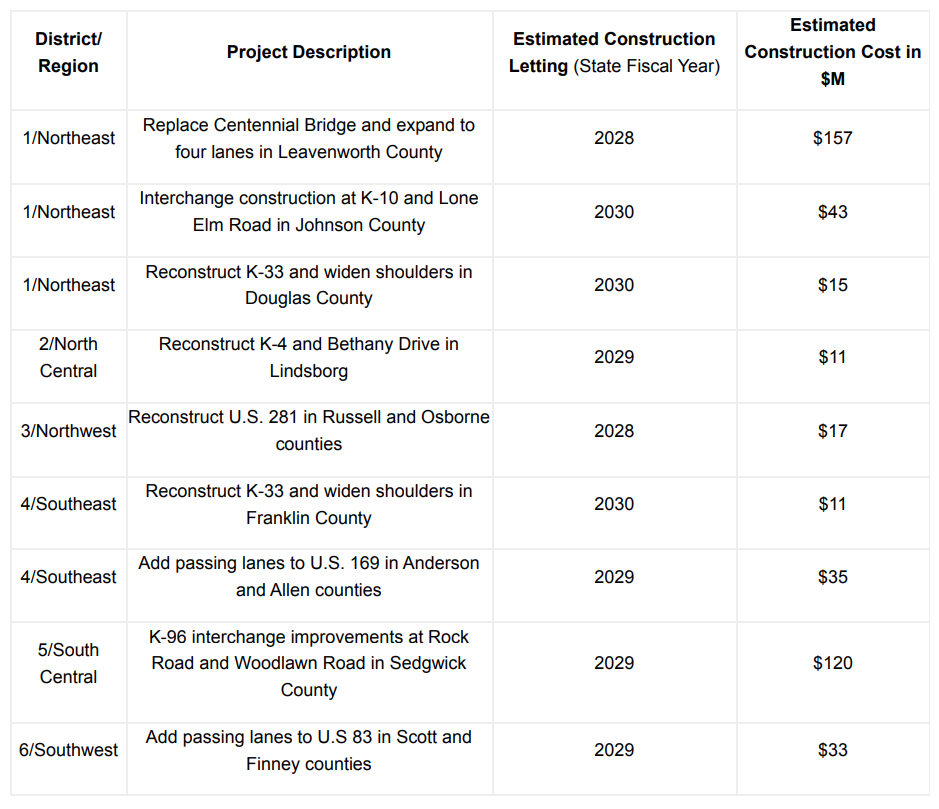
It is essential to examine the individual projects that comprise this massive investment. The projects have been strategically allocated across different regions, each addressing local needs while contributing to a broader state strategy of improved transportation and economic growth. The following table provides an overview of these initiatives:
| District/Region | Project Description | Estimated Construction Letting (State Fiscal Year) | Estimated Construction Cost ($ Million) |
|---|---|---|---|
| 1/Northeast | Replace Centennial Bridge and expand to four lanes in Leavenworth County | 2028 | 157 |
| 1/Northeast | Interchange construction at K-10 and Lone Elm Road in Johnson County | 2030 | 43 |
| 1/Northeast | Reconstruct K-33 and widen shoulders in Douglas County | 2030 | 15 |
| 2/North Central | Reconstruct K-4 and Bethany Drive in Lindsborg | 2029 | 11 |
| 3/Northwest | Reconstruct U.S. 281 in Russell and Osborne counties | 2028 | 17 |
| 4/Southeast | Reconstruct K-33 and widen shoulders in Franklin County | 2030 | 11 |
| 4/Southeast | Add passing lanes to U.S. 169 in Anderson and Allen counties | 2029 | 35 |
| 5/South Central | K-96 interchange improvements at Rock Road and Woodlawn Road in Sedgwick County | 2029 | 120 |
| 6/Southwest | Add passing lanes to U.S. 83 in Scott and Finney counties | 2029 | 33 |
This comprehensive table underscores how state funds are being allocated in a balanced and strategic manner—ensuring that no single area is overlooked. While each project brings its own set of intimidating construction challenges, the overall outlook remains positive, with projects positioned to breathe new life into aging administrative and transport infrastructures.
Marketing the State: How Infrastructure Investment Shapes Kansas’s Future
Investment in public infrastructure is not just a matter of construction; it is a potent tool for marketing and positioning a state on the competitive map. In today’s economic climate—riddled with tension and loaded with issues that challenge growth—Kansas is taking a front seat in demonstrating that long-term planning and state sponsorship can make a big difference. By modernizing highways and critical interchange systems, the state showcases its commitment to being a place where business thrives and innovation is welcomed.
This commitment sends a strong signal to potential investors and business leaders across industries, including small business, industrial manufacturing, and even sectors like electric vehicle production. A state that invests super importantly in its foundational networks not only improves quality of life for residents but also stakes its claim in an increasingly competitive nation where infrastructure quality frequently serves as a bellwether for overall economic health.
Key Marketing Takeaways for Kansas
- Enhanced Investor Confidence: A well-planned infrastructure project can significantly boost investor confidence, which is crucial for attracting future capital investments.
- Competitive Edge: Robust public works projects can set a state apart as a forward-thinking environment for new technologies, including automotive innovations and EV advancements.
- Regional Integration: Improved road networks help integrate diverse regions, making it easier for businesses to expand their market reach and for communities to share in the benefits of economic growth.
- Economic Resilience: Well maintained and modernized infrastructure is one of the key markers of an economy ready to withstand economic headwinds and changing market dynamics.
In a time when many regions are focusing on short-term fixes, Kansas’s long-term approach stands out. Investors, business planners, and economic strategists appreciate the importance of thinking ahead—recognizing that the state’s ability to adapt its core infrastructure to modern needs is integral to sustained success.
Working Through the Challenges: The Road Ahead
No large public works initiative comes without its share of intimidating hurdles and complicated pieces. Issues such as funding allocation, environmental impact studies, and community consultations require that state planners work closely with local administration and stakeholders. While the planning phase may be filled with nerve-racking twists and turns, the overall long-term benefits far outweigh these temporary challenges.
Government officials, engineers, and business leaders are all tasked with making their way through these tricky parts. Their shared understanding is that by addressing hidden complexities head-on through collaboration, the state can build roads that are not only physically robust but also primed to support profitable business ecosystems. In this realm, every decision—no matter how small—can have lasting economic implications.
Steps for Successful Implementation
- Community Involvement: Consistent dialogue with local residents ensures that their concerns and ideas are integrated from the start.
- Transparency in Budgeting: Clear reporting on fund allocation helps build trust between the government and its taxpayers.
- Environmental Oversight: Sound environmental practices must be observed to prevent adverse effects on local ecosystems.
- Adaptive Planning: Flexibility in planning allows for adjustments should unexpected challenges arise during construction.
These strategies illustrate that while the path to modernizing infrastructure is filled with challenging bits and nerve-wracking situations, careful planning and robust management will ultimately lead to success. The state is poised to reap the rewards of investing super importantly in systems that will continue to serve the community for generations.
Lessons for Small Businesses and Entrepreneurs
The ripple effects of these projects are expected to extend well beyond the realm of transportation. Small businesses and startups, particularly those in fields such as automotive innovation and local manufacturing, will find a new landscape ripe with opportunity. Improved infrastructure can lead to a more efficient flow of goods, a reduction in operational costs, and new avenues for growth that few could have anticipated just a decade ago.
Entrepreneurs should take a closer look at how these developments can alleviate some of the confusing bits related to logistics. Widened roads, safer interchange designs, and more direct routes can, in turn, reduce delivery times and create more reliable supply chains. This is especially critical for industries that rely on precise scheduling and efficient transportation networks. By having the state take the wheel on these projects, businesses are virtually stepping into a more supportive and less constricted operational environment.
Opportunities for Small Business Growth
- Logistics Optimization: Upgraded roads decrease transit times and improve overall logistics—key factors that can boost the efficiency of small enterprises.
- Enhanced Customer Access: A better regional infrastructure may expand a small business’s potential customer base as road access improves accessibility from the surrounding areas.
- Cost Savings: Reduced transportation costs can translate directly into savings that small businesses can reinvest in growth and innovation.
- Networking Prospects: Better connectivity encourages the convergence of local industries and facilitates regional business collaborations.
Ultimately, the continuous improvement of local infrastructure stands as a beacon of hope for entrepreneurs who have often grappled with off-putting logistical challenges. The state’s commitment to long-term investment ensures that business owners have the tools necessary to evolve their operations in concert with the changing times.
Long-Term Vision: Embracing Change in a Dynamic Landscape
This ambitious $442 million investment is more than just a series of construction projects—it is a testament to Kansas’s determination to invest in its future. Each modernization project is a step toward building a resilient economic foundation, one that benefits communities, local businesses, and even the automotive and electric vehicle industries alike.
While the days ahead might be filled with nerve-wracking decision-making and navigating tricky regulatory matters, the overall trajectory is one brimming with promise. The state’s willingness to invest in the little details—those fine points of infrastructure planning—signals a readiness to evolve and adapt. Rather than being stalled by off-putting hurdles, Kansas is taking the initiative to ensure that its core operational systems are robust and ready for the future.
Key Takeaways for a Bright Future
- Strategic Investment: Large capital injections into public infrastructure reframe the state’s economic roadmap, providing a competitive edge on a national scale.
- Community Empowerment: Projects like the Lindsborg reconstruction not only improve the physical landscape but also empower communities by fostering increased local commerce and job creation.
- Technological Integration: By modernizing its transportation corridors, Kansas paves the way for the seamless integration of emerging automotive technologies such as electric vehicle charging networks.
- Economic Resilience: Long-term investments help create a buffer against economic downturns, ensuring that local communities and businesses remain competitive even in challenging times.
For residents, business owners, and policymakers alike, these projects offer a renewed sense of optimism. Every new interchange, widened road, and modernized bridge represents a forward-thinking solution to the long-standing, complicated pieces that have once held back Kansas’s potential. By turning a critical eye to these infrastructure projects, we see not only the immediate improvements but also a cascading effect that promises to redefine prosperity in the region.
Conclusion: Building a Legacy for Future Generations
In wrapping up our look at these significant highway projects, it is clear that the initiatives spearheaded by Kansas Governor Laura Kelly and her team are setting an exemplary standard in how public infrastructure can act as a launching pad for future growth. From revitalizing local communities like Lindsborg to laying a robust foundation for the automotive and electric vehicle sectors, these projects demonstrate that when a state chooses to make super important long-term investments, the rewards can be transformative.
As we witness the planned transformations unfolding across various regions—from the reconstruction of vital interchanges to the replacement of aging bridges—we are reminded that the future is built one road, one project, and one improved structure at a time. For every entrepreneur, small business operator, and community member, these developments speak to a broader promise: that better roads and improved infrastructures can help figure a path to sustainability, growth, and a thriving economic legacy for generations to come.
While challenges remain and the implementation phases may sometimes appear overwhelming, the collective effort to align public policy with practical business needs infuses optimism into our economic discourse. It is now up to all of us—local governments, business leaders, and residents—to embrace these changes, support the necessary investments, and celebrate the grit and foresight of those making it all happen.
In a rapidly evolving economic landscape marked by both opportunities and confusing bits of bureaucracy, Kansas is finding its path by making strategic, long-term choices. The modernized highways and bridges are not merely lifelines to the present; they are the arteries that will carry us into a future where innovation meets infrastructure head-on. With each mile of road updated, we are reminded that progress is not accidental—it is built with purpose, persistence, and a profound commitment to community and commerce.
Let this renewed infrastructure serve as a reminder that great journeys start with a single step. As Kansas works through the twists and turns of modern construction projects, we can rest assured that the route ahead is bright, interconnected, and loaded with potential. The conversations happening in boardrooms, construction sites, and community meetings all point toward one common narrative: the state’s will to rise above past challenges and embrace a future where every road leads to opportunity, prosperity, and a thriving community spirit.
Originally Post From https://www.ksal.com/funding-approved-for-lindsborg-road-project/
Read more about this topic at
KS Governor announces $442 million in highway projects
Kansas officials commit $442 million to transportation …

