
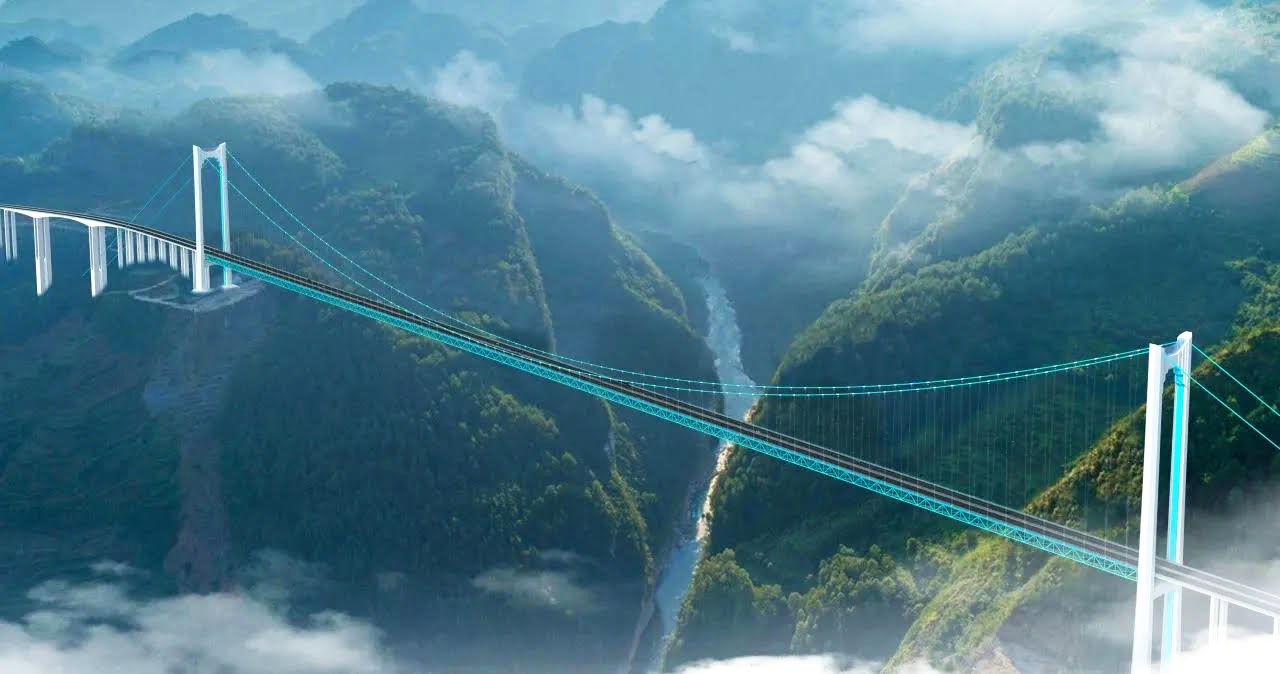
The Huajiang Grand Canyon Bridge: A Monument to Innovation and Possibility
The Huajiang Grand Canyon Bridge has emerged as much more than a mere engineering marvel—it stands as a symbol of modern infrastructure innovation in an era where nations everywhere are vying to showcase their industrial and technological strengths. As the world watches, this record-breaking bridge, poised to become the tallest of its kind, opens a fresh dialogue about the clever ways in which large-scale construction projects can influence business, automotive progress, and the economic environment on local and even global levels.
In China’s southwestern Guizhou province—a region that has long grappled with challenging economic conditions—the upcoming inauguration of the bridge is a powerful statement. Rising an astonishing 2,050 feet above ground, the structure is almost twice as high as the Eiffel Tower in Paris, a fact that sparks a renewed sense of pride in the country’s engineering achievements. However, beyond the spectacle lies an intricate web of effects on small businesses, industrial manufacturing, and even automotive industries, particularly those focused on electric vehicles.
Engineering Marvel Meets Real-World Impact
At first glance, the towering elevation of the Huajiang Grand Canyon Bridge speaks to an impressive mastery over design and construction challenges. Yet, once we take a closer look at the project’s underlying goals and economic implications, we begin to appreciate the subtle details and finer points that reveal exactly how this structure is intended to serve both as a safe passageway and an emblem of progress. In many ways, the bridge demonstrates that overcoming tricky parts of engineering—such as managing the nerve-racking heights and tangled issues of construction logistics—is an essential ingredient to fueling economic development.
In dissecting the concrete and steel behind the bridge, project planners and local officials have clearly managed to find a path through a host of intimidating and complicated pieces. They have not only tackled the visible challenges of physical construction but have also addressed hidden complexities in project financing, local workforce management, and long-term economic integration with surrounding regions.
Innovative Approaches in Modern Bridge Construction
One cannot help but admire the ingenuity showcased by the designers who have had to contend with a range of confusing bits inherent in building a structure of this magnitude. Organizers have had to figure a path around various natural obstacles, all while ensuring that the new bridge fits the evolving requirements of modern industrial manufacturing. The project is a testament to how well-planned innovation in architecture can seamlessly merge with advanced technologies to produce a physical masterpiece that not only performs its intended role but also inspires future construction endeavors globally.
To better understand the core elements that make this project so groundbreaking, consider the following key points:
- High-altitude design engineering, which required solving many tangled issues related to material stress and environmental pressures.
- Integration of next-generation safety protocols across every stage of construction, ensuring that even nerve-racking challenges are met with robust contingency plans.
- Strategic logistics planning to support a workforce capable of managing the tricky parts of dealing with both extreme physical heights and remote, mountainous terrain.
These initiatives are not isolated to the realm of engineering; rather, they ripple outwards, affecting investment trends, local business opportunities, and even influencing how governments approach urban planning and risk-taking on ambitious projects.
The Broader Economic Perspective
The ability of a region to successfully complete such a monumental project is reflective of a complex interplay between government backing, private investment, and innovative planning. In a time when many parts of the world are hung up on tangled issues surrounding economic cooperation and technical logistics, the bridge serves as a provocative example of stepping into new territory, despite intimidating challenges.
In many smaller businesses that are woven into the local economic fabric, the construction of the Huajiang Grand Canyon Bridge is seen as an opportunity to stimulate growth and create new market avenues. Whether it’s through improved access to remote areas or bolstered regional trade routes, the infrastructure project is poised to have a super important impact by acting as a catalyst for further development.
Economic Opportunities Boosted by Iconic Infrastructure
Looking at the economics of large-scale infrastructures reveals several layers of opportunity and transformation. The introduction of the Huajiang Grand Canyon Bridge into the economic mix is full of problems for those who oppose rapid change, but it is also loaded with potential for those willing to adapt. By opening access to new areas of commerce, local businesses can expect to see shifts accompanied by a host of business tax law discussions and revisions aimed at supporting such transformative projects.
For instance, the automotive and electric vehicle sectors can benefit from smoother connectivity and new markets opening along and around the route. With the promise of a revitalized supply chain, companies may see this as a perfect time to invest in the region. Additionally, small businesses, such as local manufacturers and service providers, now have the potential to grow their customer base as transport times decrease and logistical routes become more efficient.
To clarify the immediate economic benefits, consider this brief list of impacts:
- Improved transportation efficiency, cutting down on delivery times and operational costs.
- Enhanced connectivity between remote rural areas and urban centers, boosting local economies.
- New business opportunities for local contractors, materials suppliers, and service providers.
- The likelihood of favorable business tax adjustments to account for infrastructural investments.
These points illustrate a multifaceted impact where direct improvements to transportation merge with broader economic policies to ultimately create a better climate for industrial growth.
Implications for the Automotive and Electric Vehicle Industries
While the engineering feat of the Huajiang Grand Canyon Bridge is a statement in itself, its widespread influence reaches well beyond mere aesthetics. The automotive world, particularly industries focused on electric vehicles, stands to gain greatly from improved infrastructure investment. Newly accessible roads and more efficient logistics routes can trigger a domino effect of localized growth, reducing transportation costs, and increasing the reliability of supply chains over long distances.
As the automotive industry evolves to meet modern challenges, including environmental concerns and the demand for cleaner energy, infrastructures like these provide tangible support. They ease obstructive twists and turns in logistics that once made it nerve-racking for regional suppliers to get their products to market. With shorter transit times and improved route safety, manufacturers can streamline processes and improve overall economic performance.
Boosting the Electric Vehicle Supply Chain
The construction of the Huajiang Grand Canyon Bridge is potentially a game-changer in the realm of electric vehicles. Consider the following advantages that arise from such industrial progress:
- Reduced transportation bottlenecks: Electric vehicle components, many of which are produced in geographically dispersed locations, will find that improved infrastructure enables more efficient routing with fewer twisted or tangled issues related to delays.
- Lower logistics costs: The integration of this infrastructure project into the broader transportation network means that suppliers can reduce the nerve-racking obstacles of high transit expenses and maintenance issues on older, less reliable routes.
- Increased regional production capabilities: Enhanced road networks attract additional investments in local manufacturing facilities, thereby stimulating both supply and demand within automotive and electric vehicle sectors.
These improvements highlight how a visionary approach to infrastructure can do more than just accommodate existing business; it actively redefines the entire supply chain. In this manner, even sectors that appear only loosely connected to bridge-building find the small twists and fine shades of inspiration to continually press forward in the technological race.
Residential and Small Business Triumphs Amidst Infrastructure Growth
For the residents of Guizhou and surrounding regions, the new bridge is a beacon of hope—a sign that even the trickiest parts of regional geography can be overcome with enough resolve. For small business owners, this translates into enormous opportunities to branch out and tap into markets previously considered too remote or logistically challenging.
Local entrepreneurs can now access a broader customer base, and improved transportation routes pave the way for increased tourism in the region. Moreover, by fostering a better connection between urban and rural communities, this project encourages a more engaged, interconnected local economy. With easier access to new products and services, customers will be better served, and suppliers will benefit from stronger sales growth.
Advancing Local Business Through Infrastructure Expansion
Small business owners are finding creative ways to transform infrastructural investments into tangible benefits for their operations. Here are a few ways in which enhanced infrastructure, typified by the Huajiang Grand Canyon Bridge, can bring additional success to local economies:
- Enhanced market reach: Businesses can leverage improved transportation networks to expand their customer base beyond traditional regional boundaries.
- Streamlined supply chains: By cutting down on travel times and reducing logistical delays, companies can operate more efficiently, thus increasing profitability.
- Opportunities for regional tourism: With a landmark that attracts international attention, the area becomes a new destination for tourists, resulting in increased revenue for local businesses such as restaurants, hotels, and craft stores.
- Job creation: Infrastructure projects typically generate numerous employment opportunities, from construction to ongoing maintenance and operation, stimulating local labor markets.
Each of these benefits is interrelated, forming a mesh of support for small businesses that must work through the nerve-racking administrative and operational challenges that come with rapid development. Over time, such transformative projects are likely to push local economies to new heights, similar to the skyline-defining impact of the Huajiang Grand Canyon Bridge.
Unpacking the Policy and Business Tax Law Perspectives
Beyond the immediate economic and industrial impacts, major infrastructure projects often lead to a reevaluation of current business tax laws and regulatory policies. For many policymakers and business owners alike, infrastructure investments offer super important opportunities to reexamine and update existing tax frameworks. Modernizing these policies can help in financially supporting large projects while at the same time catalyzing further growth in the local and national economies.
In the case of the Huajiang Grand Canyon Bridge, several aspects of the project raise important questions for regulators:
- Financing large-scale projects: How will taxpayers, local businesses, and potentially foreign investors play a role in funding such colossal undertakings?
- Tax incentives and deductions: Which new incentives can be put in place to ensure that businesses in affected areas can thrive while sharing in the infrastructural benefits?
- Local versus national benefits: How will fiscal policies be adjusted to make sure that while the nation reaps the glory of a record-breaking bridge, local communities also obtain their fair share of economic upgrades?
Policy analysts argue that restructuring business tax law could have a domino effect on both emerging industries and older, more traditional sectors. For example, automotive companies and small manufacturers may enjoy tax breaks for investing in cleaner, more efficient production lines in tandem with the robust infrastructure improvements taking place across the country.
Key Policy Challenges and Proposed Solutions
Working through such policy issues is never straightforward. However, by taking a closer look, we can identify some super important areas that require attention, including:
| Policy Area | Challenge | Potential Solution |
|---|---|---|
| Infrastructure Funding | Mixing public and private investment while avoiding overwhelming risks for taxpayers | Implementing well-structured public-private partnerships with risk-sharing protocols |
| Tax Incentives | Finding the right balance between stimulating investment and maintaining fiscal responsibility | Designing targeted tax breaks that align closely with regional developmental goals |
| Local Economic Support | Ensuring that the benefits of large projects extend to smaller businesses | Establishing grants and low-interest loans to help local entrepreneurs capitalize on new opportunities |
These policy measures, while seemingly straightforward, involve a series of twisted and intertwined issues that require an ongoing dialogue between government bodies, local agencies, and private investors. Only by taking the time to poke around these hidden complexities can effective and sustainable policies be put into place.
Assessing the Global Implications
While the Huajiang Grand Canyon Bridge is undeniably a cornerstone achievement for China, its success has ramifications that extend far beyond national borders. In today’s interconnected world, large-scale infrastructure developments serve as benchmarks for global progress. Many nations look to such projects as evidence that ambitious goals are not only possible but may also be adapted to various geopolitical and economic contexts.
For other countries contemplating similar initiatives, the success of the bridge represents a case study in overcoming intimidating physical challenges and tangled issues—ranging from environmental considerations to the nitty-gritty of project management. It is a reminder that with the right mix of technical expertise and strategic investment, even the most nerve-racking ventures can pave the way for far-reaching benefits.
International Business and Infrastructure Inspiration
Internationally, the bridge is already inspiring a surge of interest from various domains:
- Cross-border collaborations: Countries are looking at ways to share expertise and develop trilateral or multilateral projects that mimic the innovative aspects seen in Guizhou.
- Technological transfers: Engineering firms specializing in high-altitude constructions are finding joint ventures with overseas counterparts both profitable and full of potential.
- Competitive benchmarking: Governments in various regions are assessing their own infrastructure projects and borrowing key ideas—from safety protocols to workforce training programs—to improve homegrown projects.
These understated advantages remind us that every significant infrastructure project carries with it an international ripple effect. The excitement triggered by China’s tallest-ever bridge is sufficient to encourage similar, inventive approaches globally—pushing nations to work through the challenging pieces of outdated systems and to invest in future-forward designs.
Steering Through the Future: Challenges and Opportunities
No groundbreaking project is without its nerve-racking twists and turns. As impressive as the Huajiang Grand Canyon Bridge is, its realization has not been free of complicated pieces and mixed opinions. Critics have raised concerns regarding environmental impacts, funding stability, and the long-term manageability of such ambitious structures in regions that are already managing a myriad of tangled issues.
Yet, the challenges observed here also present valuable opportunities for improvement. In managing your way through both the visible and hidden complexities, regional governments and business leaders have a chance to set new benchmarks for operational transparency and commitment to sustainable development. By openly addressing potential environmental repercussions and focusing on balanced economic benefits, policymakers can ensure that these investments yield a positive legacy for future generations.
Key Challenges and How to Address Them
When evaluating a project of this magnitude, it is crucial to consider the following aspects:
- Environmental Sustainability: Integrating eco-friendly practices during construction and operation to reduce the overall impact on natural ecosystems.
- Financial Oversight: Developing rigorous oversight mechanisms that allow both local and central governments to monitor expenditures and ensure that tax dollars are used super importantly.
- Community Integration: Ensuring that rural and urban communities alike understand and benefit from the project, thus minimizing feelings of exclusion.
- Risk Mitigation: Establishing contingency protocols to address unexpected technical or financial setbacks, making it easier to sort out issues as they arise.
By taking the wheel in planning for these risk factors and by honing in on the subtle details that make a bridge more than a passageway, all stakeholders can figure a path toward an infrastructure project that not only impresses on paper but also brings tangible benefits day after day.
The Intersection of Business, Policy, and Technological Advancement
The construction of the Huajiang Grand Canyon Bridge sits squarely at the crossroads of modern business policy and technological advancement. As companies and governments worldwide try to steer through the often tangled issues of progress in an increasingly digital age, this initiative reinforces the notion that infrastructure investments remain as critical as ever. Whether it is the automotive sector reaping improved logistics support, or small businesses benefiting from better market connectivity, the significance of advancing infrastructural capabilities cannot be overstated.
By merging the latest technological innovations in both construction and digital data management, projects like these introduce a new era of proactive economic planning. This creates a fertile ground for dynamic partnerships between traditional manufacturing powerhouses and pioneering tech companies—encouraging cross-industry dialogues that may lead to better business tax laws, more supportive regulatory frameworks, and fresh ideas to help chart a brighter future for domestic and international markets alike.
How Advancements in Technology Complement Infrastructure Projects
Several key aspects underline this perfect marriage of technology and tangible infrastructure:
- Real-Time Monitoring and Data Analytics: Advanced sensors and data systems help oversee the bridge’s structural integrity and forecast maintenance needs, ensuring that even in the face of nerve-racking challenges, the project runs smoothly.
- Automated Construction Processes: The integration of robotics and AI in manufacturing processes significantly cuts down manual errors while managing the confusing bits of heavy workloads and safety concerns.
- Enhanced Communication Networks: High-speed connectivity and real-time communications among construction teams allow for quick problem-solving and better adaptation to on-site issues, signaling a shift in how traditional projects are managed.
These examples underscore that emerging technologies are not merely accessories in large-scale infrastructure projects—they are super important enablers that elevate the entire field, paving the way for safer, more efficient, and economically rewarding outcomes.
Concluding Thoughts: Bridging the Past with the Future
The Huajiang Grand Canyon Bridge is more than just a record-breaking structure; it is a dynamic beacon for the future of infrastructure. In an era when working through the tangled issues of modern progress is essential, projects of this scale remind us that no challenge is too overwhelming when met with ingenuity, strategic funding, and a spirit of innovation.
This bridge is set to transform perspectives—both literally and figuratively—by providing an essential link that connects remote regions with the bustling hubs of economic development. It challenges established norms, providing a blueprint for how future infrastructure should be planned, financed, and integrated with local communities and industries.
As policy makers, business leaders, and engineers work together to take a closer look at the twisted parts of traditional infrastructure, they must also celebrate what has been achieved. The grand achievement in Guizhou is proof that despite nerve-racking challenges and intricate technical details, a bold vision can indeed pave the way for a brighter, more connected future.
Looking ahead, the Huajiang Grand Canyon Bridge not only exemplifies the merging of engineering brilliance with economic strategy but also calls on governments and businesses around the world to embrace groundbreaking ideas. It is a call to get into the heart of progress—where local small businesses and large industries alike can flourish through better roads, improved connectivity, and supportive business tax reforms.
Ultimately, the bridge stands as an enduring symbol that aims to instill confidence in the collective ability to steer through the off-putting twists and turns of modern development. By digging into every tricky part and addressing every confusing bit, we lay the groundwork for an infrastructure that is resilient, sustainable, and ready to meet the challenges of tomorrow.
The legacy of the Huajiang Grand Canyon Bridge will be measured not only by its towering height but also by its capacity to inspire continued investments in local economies and to redefine how the world approaches infrastructure development. In this light, it brings forward a powerful reminder: that strategic planning, ingenuity, and a commitment to embracing new opportunities are the building blocks of a robust, inclusive, and forward-thinking global economy.
As onlookers from around the world anticipate the official opening of this engineering marvel, we are invited to reflect on how far we have come—and how much further we can go when ambition meets opportunity. Let this bridge be a metaphor for progress: a testament to human creativity that encourages us to steers through challenges, open up new horizons, and ultimately, bridge the gap between today’s limitations and tomorrow’s possibilities.
Originally Post From https://www.washingtonpost.com/world/2025/09/15/china-tallest-bridge-huajiang-grand-canyon/
Read more about this topic at
🚧 Engineering Marvel: China Carves Highway Through …
China’s Engineering Marvel Declared Safe: World’s Tallest …
